
Caileane Thurston
lantern staff

During the college experience, getting educated and getting the most out of that education
is one of the goals. To make it possible , it is essential for the students to be able to wisely choose their classes and the format in which they want to take said classes. This raises the question, ‘What is the best option between face to face, online or a blended class?’
Choosing the right kind of class is probably a 90 to a 100% critical decision for long term academic success. To determine between those three options is the best one, two professors agree respectively: Professors of Chemistry Robert Carlson and Patrick Emery.
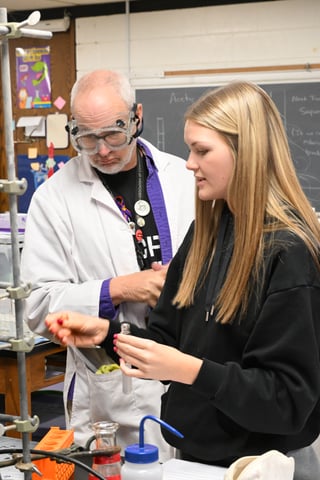 Robert Carlson, professor of physics, helps a student during one of his labs. Photo by Isaac Rich
“Online classes have their purpose and place,” Carlson said. “Just not everybody should be taking an online class.”
Carlson has taught for 41 years, and 36 of those years have been at Butler CC. He has taught online and face to face classes.
”A lot of students thought it (online) was going to be easier,” Carlson said. “When it really isn’t because now the pressure’s on you and there’s less pressure on me to teach.”
Carlson recommends that students take face-to-face classes over online courses based on his own experience.
”Your butt in the seat makes a difference on your performance in a face to face (class),” Carlson said. “You can skip all you want. You’re not going to be successful, but if you show up (and) participate, your chances of success are even higher.”
In order to be successful in online classes, students must have discipline on top of being responsible and focused. The students have to be able to teach themselves the course , and be capable to fulfill their engagement toward the class. This can require a lot of responsibility that some students may not have.
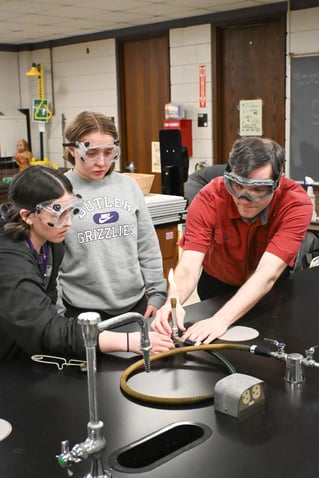 Patrick Emery, professor of chemistry, leads students through an experiment. Photo by Isaac Rich
Emery teaches face to face, online and blended courses. By definition, a blended course combines face to face and online instruction. For instance, a student will have a scheduled face to face course with other classmates and the instructor, yet the coursework is done online. Emery has taught for nine years and six of those years have been at Butler CC.
During Covid-19 pandemic, Emery began teaching blended courses.
“One of the biggest challenges while taking an online class is to make sure that you stay up to date with the material,” Emery said. He also advises to “find material that you understand out of the material given in class’’ to make sure that students understand it better.
Like Carlson, Emery prefers face-to-face classes because “it gives me more time to interact with students” he said. Emery has found out that “as an instructor, the more interactive you can make a class, whether it be blended, in person or online, the stronger the student feels about getting involved in the class.”
Ivy Okaru, a Nursing major student, has taken a blended class in the past.
“Overall, I actually enjoyed the blended class,” Okaru said. “It felt like a good mix of structure and flexibility, and I liked being able to learn in different (ways).”
Okaru prefers blended classes because “ fully online classes can feel a bit isolating, and fully in-person ones sometimes don’t fit my schedule as well. The blended format gave me the best of both worlds. I could interact face-to-face but also work at my own pace when needed.”
For Okaru, she learned the most during in-person sessions because she could ask questions right away and discuss things with classmates, yet Okaru liked having online materials to review at home.
As students weigh their options each semester, the choice between face-to-face, online and blended classes ultimately comes down to learning style, discipline and personal schedule. While both Carlson and Emery emphasize the value of in-person interaction and engagement, they acknowledge that online and blended formats can be effective when students are prepared for the responsibility they require. Okaru’s experience highlights that flexibility and structure can successfully coexist in a blended setting. In the end, there is no single “best” format for everyone—only the one that best supports a student’s commitment, participation and long-term academic success.
Caileane Thurston
lantern staff
Alexis DeLong
managing editor